
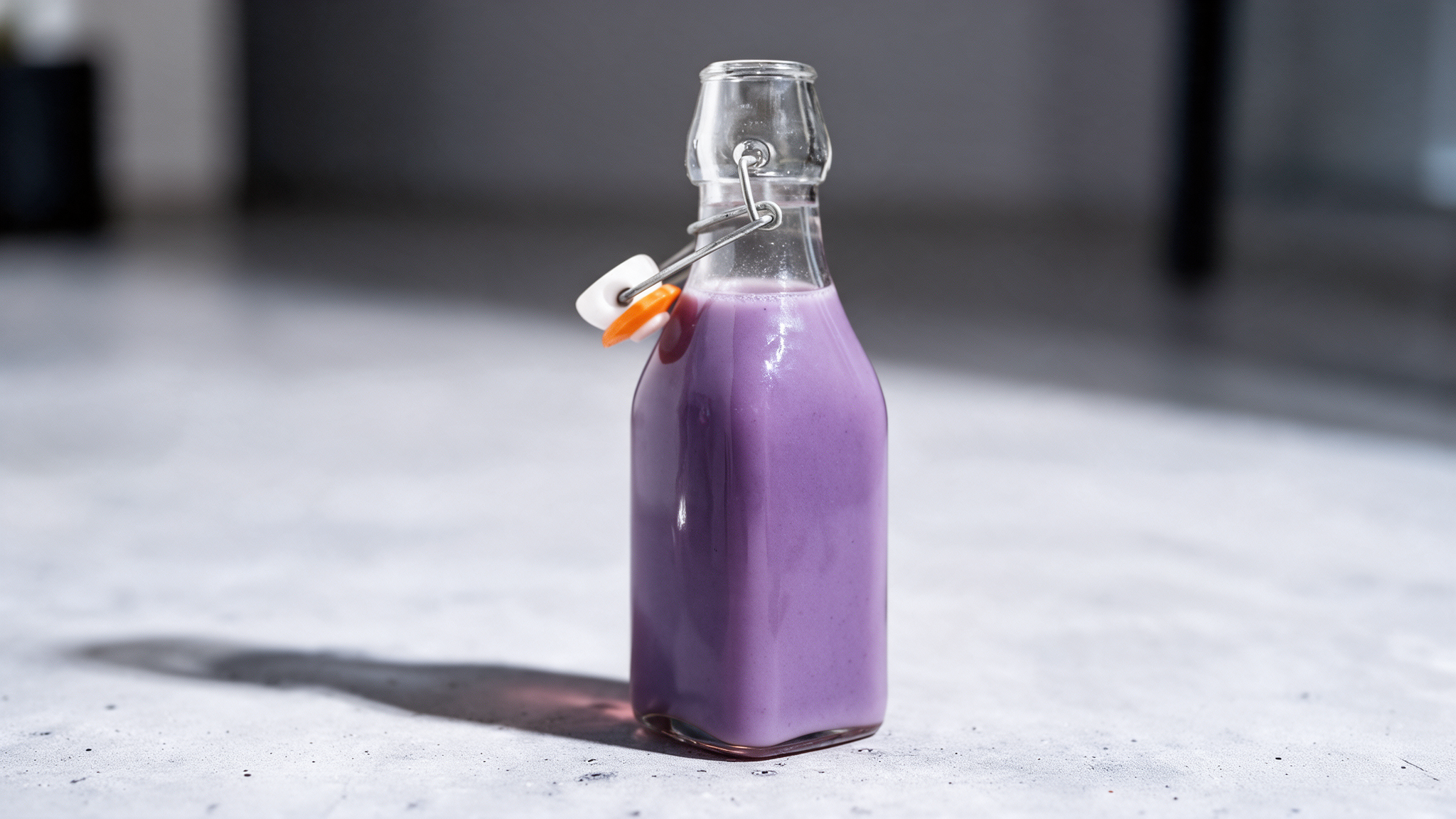
The basics of a stable and homogeneous formulation
Making high-quality cannabis syrup is more challenging than it might initially seem. The biggest challenge is distributing fat-soluble ingredients evenly throughout a water-based liquid. Cannabinoids such as THC and CBD are barely soluble in water. If they are simply mixed with a sugar-water solution, they will not distribute evenly. The oil may separate or form a visible film on the surface. To prevent this, the principles of emulsion technology are used. This involves mixing one liquid with another in the form of finely dispersed droplets. For a syrup containing fat-soluble ingredients, the desired system is what is known as an oil-in-water emulsion. In this system, small oil droplets are distributed as evenly as possible throughout the water-based syrup.
The role of MCT oil and lecithin
MCT oil is suitable as a carrier for fat-soluble ingredients. It consists of medium-chain triglycerides and generally remains liquid at normal refrigerator temperatures. Cannabinoids can dissolve in it and thus be incorporated into an emulsion system.
A suitable emulsifier is needed to distribute the oil evenly throughout the water. One option is lecithin.
Lecithin is a natural emulsifier obtained, for example, from soybeans or sunflowers. Its special property is that its molecules have both a water-loving and an oil-loving part. This allows them to attach themselves at the point where oil and water meet, helping to distribute small oil droplets evenly throughout the water.
Lecithin therefore helps oil and water combine more effectively. It does not automatically prevent the two ingredients from separating again during prolonged storage.
This process is known as emulsification. The cannabinoids remain in the oil phase or are dissolved in it.
The ingredients and their functions
MCT oil
MCT oil serves as a fat-soluble carrier medium. It can absorb fat-soluble ingredients and allows them to be incorporated into a water-based emulsion system. Its use is particularly practical because of its relatively low viscosity and good processability.
Lecithin
Lecithin is an established emulsifier in food technology. It supports the distribution of the oil throughout the water and can help prevent the oil droplets from clumping together as easily.
How well this works depends on the overall composition of the emulsion and the quantities used. Lecithin alone does not guarantee long-term stability.
Sugar
Sugar is an essential component of the syrup base. It provides the desired sweetness, affects the consistency and can reduce water activity. The extent of this effect depends on the overall formulation. A high sugar content alone does not automatically make a water-based syrup shelf-stable.
Vegetable glycerin
Glycerin is a colorless liquid with a slightly sweet taste. It binds water and influences the physical properties of a formulation. It can be used in syrups to adjust consistency and also acts as a humectant.
Xanthan gum and gum arabic
Both substances are used in food production as stabilizers, thickeners and emulsifying aids.
Xanthan gum increases the viscosity of the water phase. This slows down the movement of oil droplets, which can reduce creaming in the emulsion.
Gum arabic also has emulsifying properties and can help stabilize oil droplets in suitable formulations.
The two substances have different properties and therefore cannot simply be substituted for one another.
What makes an emulsion stable?
A freshly prepared emulsion often looks completely homogeneous at first. However, this does not necessarily mean that it will remain stable over a longer period.
Various changes can occur during storage:
- Creaming: Oil droplets collect at the surface due to differences in density.
- Flocculation: Individual oil droplets gather together into larger clusters.
- Coalescence: Several small droplets merge to form larger oil droplets.
- Phase separation: The oil and water separate visibly from one another.
Emulsifiers and stabilizers can slow down these processes. Whether a formulation actually remains homogeneous over an extended period can only be determined through appropriate stability testing.
How emulsification affects absorption in the body
Since cannabinoids are poorly soluble in water, their formulation plays an important role in their absorption through the digestive tract.
Certain emulsion systems can improve the distribution of fat-soluble active ingredients and, under suitable conditions, may also increase their oral bioavailability. Particularly finely dispersed emulsions can offer advantages in this respect.
Not every emulsion is automatically more bioavailable than an oil-based formulation. Important factors include the size of the oil droplets, the composition of the oil phase, the emulsifier used and how the formulation behaves during digestion.
Shelf life and storage
Since this type of syrup contains water, it can spoil if stored improperly. Although sugar and glycerin can influence shelf life, they do not provide reliable protection against yeasts, molds and bacteria on their own.
For household storage, it is therefore advisable to use clean, tightly sealed containers and generally keep the syrup refrigerated. It should also be protected from light and heat as much as possible. It is important to understand that without microbiological testing, no reliable shelf life in days or weeks can be specified. Even a liquid that looks unchanged is not necessarily microbiologically safe.
Our recommendation: For homemade, water-based syrup without a tested preservation system, assume a short shelf life and use it promptly. A laboratory analysis would be necessary to determine the exact cannabinoid concentration.
Die verwendete Kombination aus MCT-Öl, Lecithin und Xanthan sorgt für eine gute Grundlage zur Herstellung eines homogenen und stabilen Sirups. Allerdings wird dieser wahrscheinlich nicht vollständig klar, sondern eher leicht milchig oder trüb sein. Das liegt daran, dass Lecithin kleine Öltröpfchen im Wasser verteilt, die das Licht streuen. Xanthan unterstützt zusätzlich die Stabilität, indem es die Flüssigkeit verdickt. Das Ergebnis ist somit eher ein gleichmäßiger, leicht opaleszenter Sirup als eine kristallklare Flüssigkeit.
Storage conditions:
Temperature, light and packaging can all affect product quality. For cannabinoid-containing products in particular, it is also important that the active ingredients are distributed as evenly as possible throughout the entire product.
What makes a high-quality cannabis syrup?
A good cannabis syrup should not only taste pleasant and mix easily into drinks. What matters is that its composition is well understood and that its quality is maintained during storage.
This includes even distribution of the ingredients, the greatest possible emulsion stability, a reliable active ingredient concentration and microbiological safety. Ultimately, what matters is not how homogeneous a syrup looks immediately after preparation, but whether these properties are maintained under the intended storage conditions.

Ingredients
1. For the cannabis oil base (The active ingredient carriers):
- Cannabis flowers: 5g to 7g (well dried)
- MCT oil: 30 ml (equivalent to approx. 2 tablespoons)
- Liquid lecithin (sunflower or soy): 5 ml (equivalent to 1 teaspoon)
2. For the syrup base:
- Water (preferably distilled or filtered): 350 ml White refined sugar: 400 g (Important: White sugar ensures a more stable emulsion structure than brown sugar)
- Vegetable glycerin: 45 ml (equivalent to 3 tablespoons)
- Optional professional stabilizer: Xanthan gum: 1 g (approx. 1/4 teaspoon) or Gum arabic: 3 g (to prevent the oil from settling on top later).
How it works
1. Perfect decarboxylation: activation: Preheate the oven. Bake the coarsely crushed flowers at a constant 115 °C for exactly 40 minutes. (Ideally use an oven thermometer, as household ovens are often inaccurate).
2. Lipid extraction: water bath: Place the activated flowers, MCT oil, and lecithin into a clean mason jar. Seal it tightly and place it in a water bath. Let it steep at a temperature of 70 °C to 80 °C for exactly 3 hours. Shake the jar briefly every 30 minutes. Afterwards, filter the warm oil through a fine cheesecloth and squeeze it out well.
3. Production & Emulsification: The Binding: Boil the water with the sugar until the sugar is completely dissolved and the liquid is clear. Reduce the heat and add the glycerin. Now pour in the filtered cannabis MCT oil (and sprinkle in the xanthan powder, if used). Take the immersion blender and mix the hot liquid on the highest setting for 3 to 4 minutes. This mechanical process breaks the oil down into microscopically small droplets, which remain permanently suspended in the syrup thanks to the lecithin.
The combination of MCT oil, lecithin, and xanthan gum provides a good foundation for creating a homogeneous and stable syrup. But the final product will probably not be completely clear, but rather slightly milky or cloudy. This is because lecithin disperses tiny oil droplets throughout the water, causing light scattering. Xanthan gum further improves stability by increasing the liquid’s viscosity. As a result, the syrup is more likely to have a uniform, slightly opalescent appearance rather than being crystal clear.
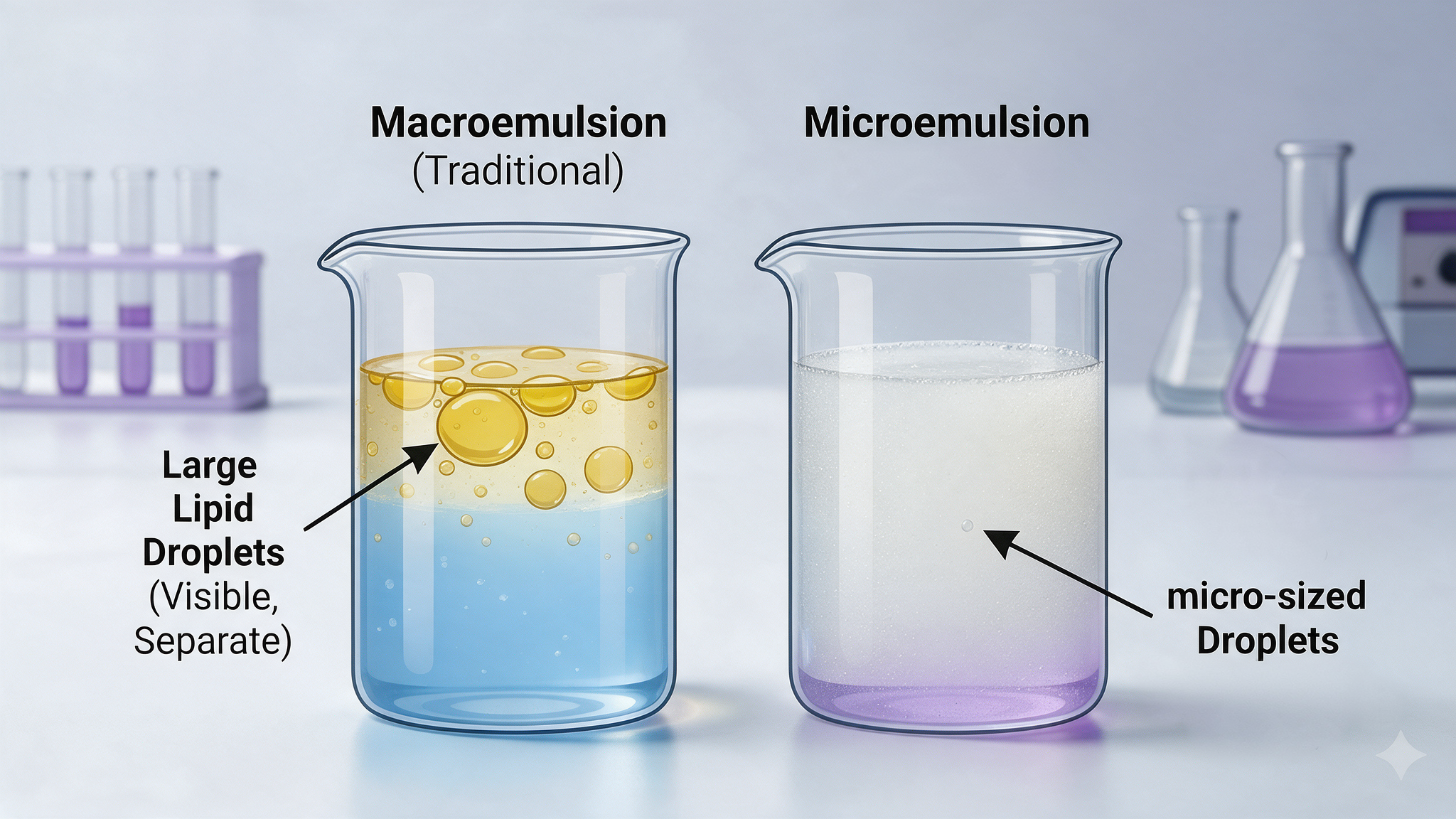
Nano-Emulsion & Micro-Emulsion: The Role of the Homogenizer
To “disrupt” droplets into the nanometer range, extremely high mechanical forces are required. In professional practice, two main types of equipment are used for this purpose:
- Ultrasonic Homogenizers (Sonicators): These operate using high-frequency sound waves that generate microscopic bubbles within the liquid. When these bubbles collapse, they produce extreme shockwaves that shatter the oil droplets down to nanoscale.
- High-Pressure Homogenizers: In this process, the mixture is forced through a tiny valve under massive pressure (often several hundred to thousands of bar). The resulting impact and shear forces reduce droplet size extremely efficiently.
A homogenizer alone is not enough to ensure long-term stability. Since glycerin is not a classic emulsifier (it primarily increases viscosity and serves as a co-solvent), you require a true surfactant or emulsifier additive (such as lecithin, polysorbate 80, or quillaja saponins).
The homogenizer generates the tiny droplets, and the emulsifier immediately coats them to prevent them from coalescing (merging back into larger droplets).
Taste and flavors
Depending on the desired taste and appearance, a syrup can generally be supplemented with suitable food colorings and food flavorings. Water-soluble colorings and flavors are particularly well-suited for water-based syrup formulations. When using oil-based flavors, care must be taken to ensure that they distribute sufficiently evenly. Additional ingredients can influence the stability and shelf life of the finished product.
Due to its water-based structure, this cannabis syrup is exceptionally versatile for culinary use. It is excellent for sweetening and enhancing both hot and cold beverages, such as teas, lemonades, or cocktails, and can also be used as a topping for desserts like pancakes, waffles, and ice cream.
