
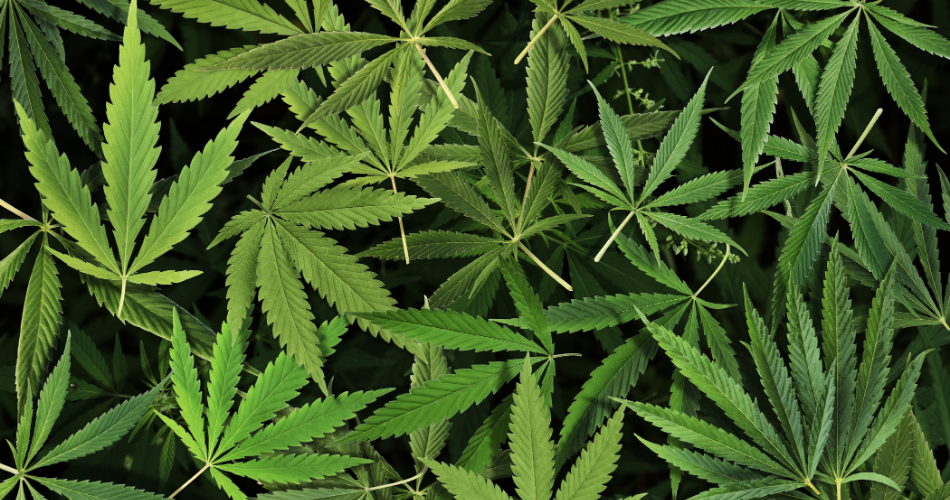
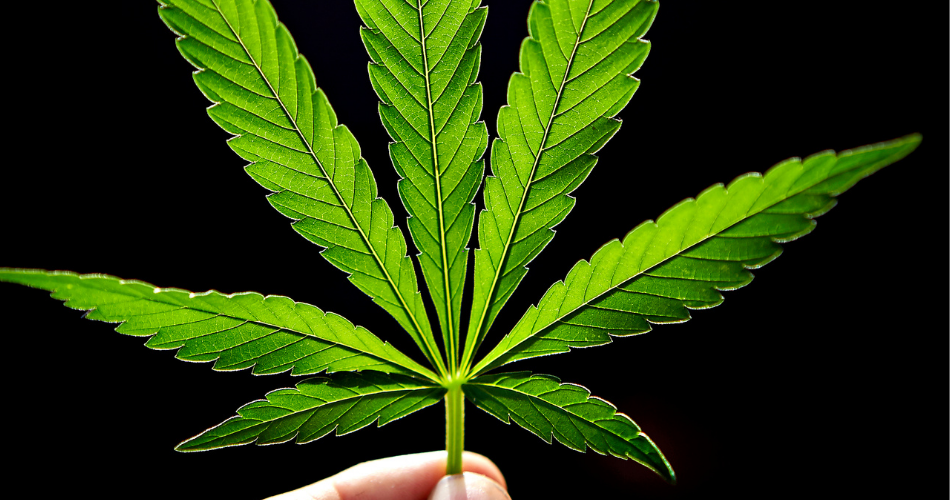
The Biological Protective Functions of Fan Leaves
- Mobile Nutrient Storage: Leaves serve as temporary storage organs for mobile nutrients such as nitrogen (N), magnesium (Mg), and potassium (K).
- The Natural Aging Process (Senescence): As leaves age, they naturally begin to senesce. During this process, stored nutrients are mobilized and redistributed to younger plant tissues and developing flowers when needed. Under natural conditions, older leaves therefore turn yellow toward the end of flowering before eventually dying off. Under optimal indoor conditions with continuous nutrient availability, however, many of these leaves remain green for much longer. As long as a leaf is healthy and green, it actively contributes to the plant’s energy production.
- The “Sponge Effect” for Nutrient Mistakes: Fan leaves act as a buffer. If you overfeed your plants, the fan leaves absorb the initial damage and typically show nutrient burn first. Without these leaves, excess nutrients may reach the flowers directly, potentially causing irreversible damage.
The Challenge of a Dense Canopy
At the same time, large fan leaves, particularly on densely growing plants, can block light from reaching lower flower sites and restrict air circulation within the canopy. In such cases, targeted and moderate defoliation can improve light penetration and increase airflow. This significantly reduces the risk of excessive humidity and fungal diseases such as gray mold (Botrytis cinerea).
The Perfect Timing: The Two-Step Method
If you decide to defoliate, it should be done as a targeted, focused procedure rather than through repeated small removals over many weeks. This minimizes repeated stress caused by frequent intervention. During the vegetative stage and up until shortly before flowering, only damaged, diseased, dead, or completely shaded leaves should generally be removed. If a full defoliation is planned time it according to the plant’s hormonal balance (auxins and cytokinins) using two critical time windows:
- Step 1: The “Day 30” Defoliation: Around Day 30 after switching to a 12/12 light cycle. At this point, the plant has developed its final structure and has nearly completed its stretch.
- What to do: Selectively remove the large fan leaves that completely shade lower bud sites. Ideally, combine this with lollipopping (see techniques below). Goal: This intervention helps bring vertical growth to an end and redirects the plant’s energy toward the upper main colas.
- Step 2: Approximately 3–4 Weeks Before the Expected Harvest.
- What to do: Remove only a few exceptionally large fan leaves in the upper and middle canopy that block light from reaching the thickening buds.
- Goal: Maximize light penetration during the final bulking phase of flower development.
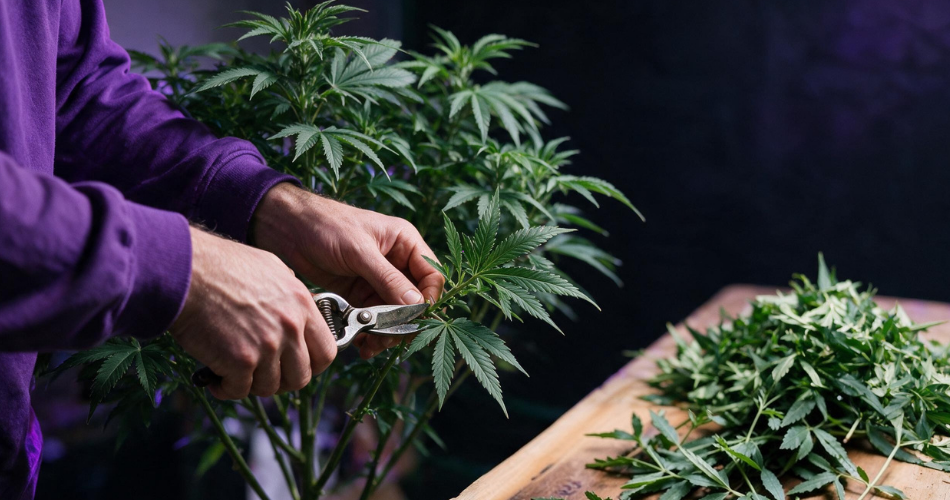
Main-lining
With main-lining (also known as manifolding), the approach to defoliation changes significantly because the plant has already been trained into a highly symmetrical structure through topping and pruning during the vegetative stage. Since the lower third of the plant has already been completely cleaned up while creating this “distribution manifold,” traditional lollipopping during flowering becomes unnecessary. Popcorn buds are largely prevented from forming in the first place. As a result, considerably less defoliation is usually required during flowering than with naturally bushy plants. The open canopy already provides excellent air circulation.
Around Day 30 and again approximately 3–4 weeks before harvest, growers generally only need to remove a few exceptionally large fan leaves that, when viewed from above, shade the flower sites of neighboring main colas.
The Two Most Important Techniques at a Glance
When modifying plant structure, growers generally distinguish between two fundamental methods:
- Defoliation: The targeted and moderate removal of individual leaves from the upper and middle sections of the plant to improve light penetration to lower bud sites.
- Lollipopping: The complete removal of leaves, shoots, and small flowers from the lower third of the plant. Since very little light reaches this area under normal conditions, it typically produces only low-quality “popcorn buds.” By cleaning up this lower growth, you prevent the plant from wasting energy and instead encourage it to focus its resources on producing larger, higher-quality flowers in the upper canopy.
What You Need to Keep in Mind (Grower’s Rules)
- Genetics and Plant Structure matter: Not every plant responds to defoliation in the same way.
- Compact Indicas: Compact, broad-leafed plants with dense canopies often benefit more from careful defoliation than plants with naturally open and airy growth habits.
- Photoperiod Sativas and Indicas: Healthy photoperiod plants generally tolerate defoliation well because they have sufficient time to recover after the procedure.
- Autoflowering Varieties: Due to their short, genetically predetermined life cycle, autoflowers are extremely sensitive to heavy pruning. They simply do not have enough time to recover. Therefore, only damaged, dead, or severely shading leaves should be removed from autoflowering plants.
- Every healthy leaf contributes to final yield.
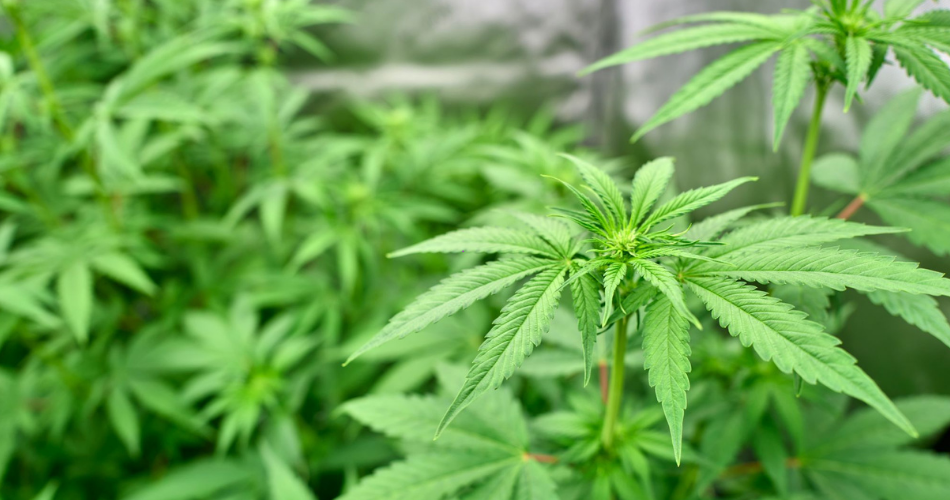
LED Lighting
Modern LED fixtures provide extremely high light output but often have less canopy penetration. For this reason, defoliation is often more beneficial under LED lighting, as light that cannot penetrate the canopy is effectively wasted.
Be Aware of Light Saturation The upper leaves often reach the light saturation point under powerful grow lights and operate at maximum photosynthetic capacity. If these leaves are removed, lower shade-adapted leaves must take over despite not being biologically adapted to such high light intensities.
Monitor Your Grow Tent Climate:
Transpiration and VPD Leaves transpire water, actively cooling both the plant and the grow environment. Regardless of timing, too much leaf area should never be removed at once.
The Risk: Removing too many leaves simultaneously can cause humidity inside the tent to drop rapidly, altering the Vapor Pressure Deficit (VPD).
The Consequence: The remaining leaves may experience severe stress and respond by closing their stomata to protect themselves. This further disrupts transpiration and, in extreme cases, can completely halt nutrient uptake through the roots.
- The Golden Rule: For this reason, never remove more than 20% to a maximum of 30% of the total leaf mass in a single session. Remove only as much foliage as is absolutely necessary to improve light penetration and airflow.
The Stress-Free Alternative: Leaf Tucking
Before reaching for the scissors and damaging plant tissue, try leaf tucking instead. This technique involves gently bending large fan leaves downward or tucking them beneath neighboring branches so that light can reach the buds underneath without obstruction.
Advantage: This method causes zero stress to the plant. It retains all of its valuable nutrient and energy reserves for late flowering while simultaneously optimizing light distribution throughout the canopy.
Conclusion
Targeted and moderate defoliation can provide clear benefits for densely foliated indoor plants under the right conditions. It improves light penetration through the canopy and promotes better air circulation, reducing the risk of excess humidity and fungal diseases.
At the same time, large fan leaves are essential photosynthetic organs and important nutrient reservoirs. Their removal should therefore always be carried out with care. Whether defoliation is ultimately beneficial depends on your specific genetics, the current plant structure, nutrient management, and overall growing conditions.
For this reason, only remove as much foliage as is absolutely necessary to minimize plant stress while maintaining a healthy balance between optimal light penetration and maximum photosynthetic performance.