
CalMag for Cannabis: Calcium, Magnesium, and Actual Nutrient Requirements
Why calcium and magnesium are so important for cannabis
Healthy cannabis plants need more than nitrogen, phosphorus, and potassium. Calcium and magnesium also play an important role in growth, leaf development, and metabolism. Both minerals are indispensable for the plant, but they fulfill different tasks. A deficiency therefore does not manifest itself in the same way, and the correct ratio is also important when it comes to the supply.
CalMag is the common term for fertilizers or supplement products that contain calcium and magnesium. They are used to compensate for an insufficient supply. However, this does not mean that every cannabis plant regularly requires an additional dose of CalMag. Whether it makes sense depends, among other things, on the irrigation water, the basic fertilizer used, the substrate, and the growing conditions.
Calcium: important for cell walls and young plant parts
Calcium is an essential building block of stable cell walls and contributes to plant tissue maintaining its structure. It is also involved in the regulation of various cellular processes. The supply to young, growing plant parts is particularly important, because new cells and tissues are constantly being created there.
Unlike some other nutrients, calcium can only be translocated from older to younger leaves within the plant to a limited extent. It is predominantly transported with the water flow through the xylem. This transport is closely related to water uptake and transpiration. If certain parts of the plant are insufficiently supplied with water or the transport is restricted, a local supply problem can arise there despite calcium being present in the root zone.
A calcium deficiency can become noticeable on young leaves and shoot tips. Distorted or unusually small new leaves, dead tissue areas, and stunted growth are possible. However, such symptoms are not unambiguous. Problems in the root zone, an unsuitable pH value, or other causes can also produce similar signs.
Magnesium: the central building block of chlorophyll
Magnesium fulfills a different task. It is a component of the chlorophyll molecule and is therefore directly involved in photosynthesis. Furthermore, it plays an important role in numerous enzymatic reactions and in energy metabolism.
In the case of an insufficient magnesium supply, the formation and function of the photosynthetic apparatus can be impaired. This often shows up first on older leaves: the areas between the leaf veins become lighter, while the veins themselves remain green longer. This pattern is referred to as interveinal chlorosis. With a more severe deficiency, dead spots can develop.
Magnesium is comparatively highly mobile within the plant. If the supply is insufficient, the plant can translocate a portion of the existing magnesium from older leaves to younger, active areas. This is why typical deficiency symptoms frequently appear first on older leaves.
Research on medical cannabis confirms how strongly the magnesium supply can influence plant development.
Morad and Bernstein investigated different magnesium concentrations during the vegetative growth phase in 2023. Under the conditions of their experiment, the plants achieved favorable results with a magnesium supply of 35 to 70 milligrams per liter. With a mere two milligrams per liter, clear deficiency symptoms occurred: the total plant biomass was 28 percent below the value of the optimally supplied comparison group.
These figures are not a universal fertilizer recommendation. They describe the results of a specific controlled experiment and cannot be readily transferred to every substrate, every irrigation water, or every fertilizer system. However, the study clearly shows that an insufficient magnesium supply can impair growth and photosynthesis.
Source: Morad and Bernstein, Response of Medical Cannabis to Magnesium (Mg) Supply at the Vegetative Growth Phase, 2023, Plants.
Why calcium and magnesium are considered together
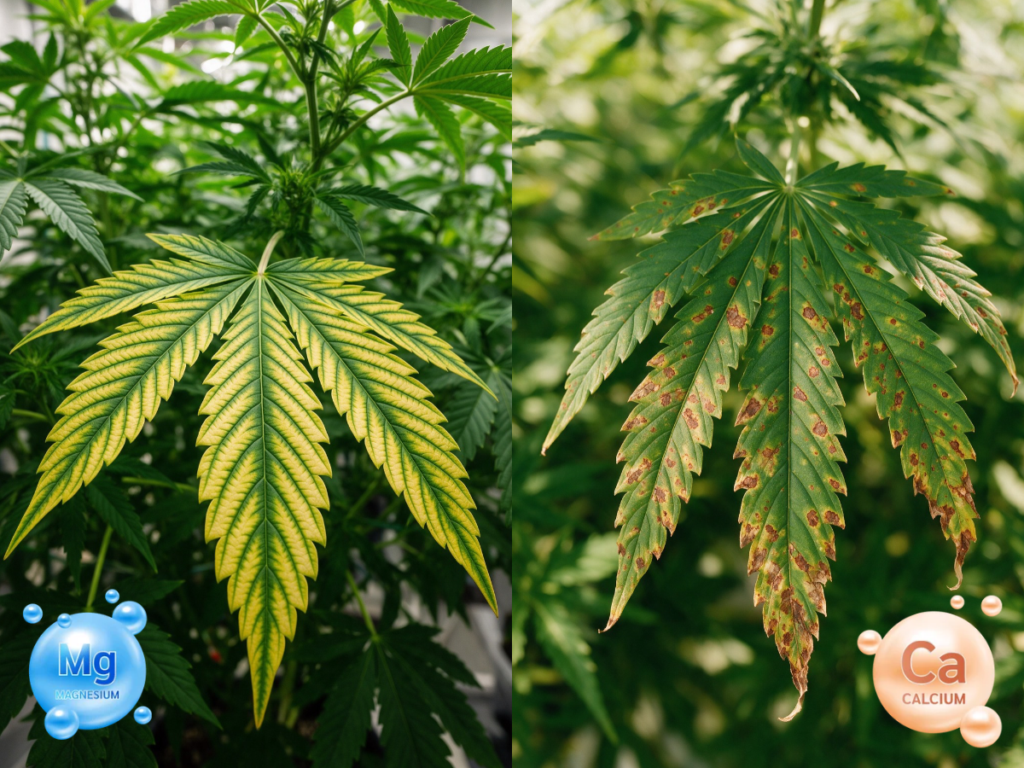
While a magnesium deficiency classically leads to yellowish yellowing between the leaf veins (interveinal chlorosis) on older leaves, a calcium deficiency manifests as characteristic brown, necrotic spots in the tissue.
Calcium and magnesium are frequently offered in a single product because both are important for plant health and can be supplemented together in practice. Nevertheless, their tasks are different. A balanced ratio is important, but it does not follow from this that every plant needs an additional mixture of both nutrients. Potassium must also be taken into account in this consideration. The uptake of calcium, magnesium, and potassium depends, among other things, on their concentration in the root zone and on the characteristics of the respective nutrient system.
An excessive supply of one mineral can impair the uptake of other nutrients. This is especially true if high concentrations are already present or if the supply is not coordinated with one another.
The 2023 study by Morad and Bernstein illustrates this connection: with increasing magnesium supply, the uptake and distribution of calcium and potassium also changed. The highest magnesium applications were therefore not automatically the most favorable. More of one nutrient does not necessarily mean a better overall supply and better results.
In practice, this means: CalMag should meet an actual requirement without unnecessarily shifting the rest of the nutrient balance.
pH and EC: What the measured values reveal
The pH value influences how well different nutrients are available in the root zone. If it lies outside the suitable range, supply problems can occur even though the mineral nutrients in question are present. Additional fertilizer does not necessarily fix the cause in that case. The electrical conductivity, or EC for short, is also helpful. It indicates the total amount of dissolved salts but does not reveal which individual nutrients are present in what concentration. A high EC value can indicate a high salt load, but on its own, it does not prove a CalMag deficiency.
pH and EC are therefore most meaningful when they are assessed together with water quality, the fertilizer used, and the condition of the roots.
How the CalMag requirement changes during growth
The nutrient requirement of a cannabis plant does not remain the same throughout its entire life cycle. As plant mass increases, water consumption, growth, and the uptake of individual mineral nutrients change. In addition, there are differences between varieties and growing conditions. A study published in 2026 by Powell and Bauerle recorded the nutrient uptake of two cannabis varieties during the vegetative phase.
The results showed variety-specific patterns. While the uptake of calcium and magnesium increased during the period studied, the uptake of other nutrients followed a different course. The work highlights that mineral requirements are dynamic and do not progress identically for every variety.
Lighting can also indirectly influence this development if it alters growth, leaf area, and water consumption.
However, it does not follow from this that a fixed additional amount of CalMag is required during every growth phase.
What remains decisive is what the plant can actually take up under the specific conditions and what is already available via the water and basic fertilizer.
An incorrect pH level (e.g., below 6.2 in soil or below 5.8 in hydro/coco) physically blocks ion uptake in the root zone. If you then blindly add more CalMag, you only increase the EC value and burn the roots.
Sources: Morad and Bernstein, vegetative phase, 2023; Morad and Bernstein, reproductive phase, 2025.
What the nutrient supply means for working with cannabis genetics
Research on nutrient uptake shows that cannabis plants cannot be viewed independently of their genetics and environmental conditions. Differences between varieties, developmental stages, and cultivation systems make it difficult to establish a single nutrient requirement for all plants. For the classification of the nutrient supply, it is therefore not only crucial which genetics are cultivated. Irrigation water, substrate, basic fertilizer, and the conditions in the root zone must also be taken into account.

If too much calcium and magnesium are dumped into the system, it leads to the following chain reactions in the plant:
1. The Blockade Trap
In the substrate and at the root cells, there is a constant battle for absorption sites. Ions with a similar charge use the same transport pathways into the plant.
- Too much magnesium (Mg²⁺): Ruthlessly pushes potassium (K⁺) and calcium (Ca²⁺) aside. The result: Despite bulging pots, the plant suddenly shows a massive potassium deficiency (visible by burned leaf edges) or, paradoxically, even a calcium deficiency.
- Too much calcium (Ca²⁺): In turn, starves out magnesium and potassium. Worse still: A massive excess of calcium in the substrate chemically binds essential trace elements such as iron, zinc, and manganese. The roots can no longer absorb them, and the plant yellows from the top down.
2. Biomass Loss and Photosynthesis Collapse
More nutrients simply do not mean more growth. As soon as the magnesium level exceeds the critical upper limit, the photosynthetic apparatus in the cells is downright overloaded. The efficiency of light processing plummets. The logical consequence over further time: The plant can convert less energy, builds up less dry matter, and the final flower and harvest weight drops noticeably.
3. Artificial Salt Stress and Root Death (Root Burn)
CalMag products are basically nothing more than salts (mostly nitrates or sulfates). Every extra dose drives up the EC value in the substrate.
If the salt concentration in the soil or coco rises too sharply, the osmotic gradient flips: The water is held back in the substrate instead of being sucked up by the roots. In the worst-case scenario, water is actually extracted from the root cells. The fine root hairs die off, the tips burn (Root Burn), and the plant thirsts to death despite wet soil.
4. Zell Wall Stiffening and Growth Stoppage
Calcium is the “concrete” for the plant cell walls and ensures stability in the middle lamella. However, if too much free calcium floats around in the intercellular space (the apoplast), the cell walls harden and stiffen much too early. The cells lack the necessary flexibility for normal elongation growth. The consequences are stunted, rigid shoots and crippled leaf structures.
The practical conclusion:
Anyone who uses CalMag on suspicion or as a pure precaution does not solve problems, but creates new ones. You maneuver the plant into a spiral of blocked nutrients, damage the root system through salt stress, and ultimately castrate your own yield.
Why a CalMag oversupply can be problematic
A study with medical cannabis showed that a magnesium supply above the favorable range reduced the flower biomass, while the investigated cannabinoid and terpene profiles remained unaffected at the high supply levels. This shows that yield and active substance concentration must be evaluated separately. In practice, this means: CalMag should not be used as a precaution or according to the principle “more helps more.” The decisive factor is whether a requirement actually exists and whether the supply of calcium, magnesium, and the remaining nutrients is in balance.
When additional CalMag supplementation can be useful
Supplementation can be useful if the irrigation water contains only little calcium and magnesium, the basic fertilizer does not sufficiently cover the supply, or there are concrete indications of a deficiency. Certain substrates and cultivation systems can also require a more precise coordination of these minerals.
With LED lighting, it is worthwhile to carefully consider light intensity and climate. High light intensity can alter growth and water balance. If the plant thereby turns over more water or forms new biomass faster, the nutrient uptake can also change. Whether this actually creates an additional CalMag requirement, however, depends on the existing supply and the other conditions.
A flat-rate dosage based solely on the lamp type is therefore not very meaningful. Two plants under the same LED can have different needs if they grow in different substrates or are supplied with different water and fertilizer. Conversely, a plant under HPS can just as easily develop a calcium or magnesium problem.
Only from the overall picture can it be deduced whether CalMag is a useful supplement or whether the cause should be sought elsewhere.
What can you actually measure at home?
pH value of the irrigation water and the nutrient solution: A pH meter shows whether conditions for nutrient uptake could be unfavorable. However, it does not show how much calcium or magnesium the plant has actually taken up.
EC value: An EC meter provides information about the electrical conductivity and thus a rough indication of the concentration of dissolved salts. It cannot distinguish whether these originate mainly from calcium, magnesium, or other nutrients.
Water analysis: An analysis of the tap water can show how much calcium and magnesium is already supplied during watering. This is often very helpful for assessing the possible requirement.
What does this mean for the homegrower?
A controlled cannabis study from the year 2023 came to an important result: visible deficiency symptoms did not in every case match the measured nutrient concentrations in the leaves. Symptoms should therefore not be evaluated in isolation, but rather multiple sources of information should be brought together.
Common home measuring devices, however, cannot directly determine the actual calcium or magnesium content in the plant tissue.
Conclusion: Understand the plant instead of re-fertilizing on suspicion
Calcium and magnesium are indispensable for the development of cannabis plants. Whether additional CalMag supplementation is useful, however, depends on many factors.
Sources and further specialized literature: Morad, D. and Bernstein, N. (2023): Response of Medical Cannabis to Magnesium (Mg) Supply at the Vegetative Growth Phase. Plants, 12(14), 2676.
https://doi.org/10.3390/plants12142676
Morad, D. and Bernstein (2025): From deficiency to toxicity: Magnesium increases cannabinoid and terpene production in cannabis plants. Journal of Cannabis Research.
https://doi.org/10.1186/s42238-025-00358-9
Powell, M. and Bauerle, T. (2026): Predicting vegetative phase nutrient uptake in Cannabis sativa L. via transpiration-driven mass-balance. Frontiers in Plant Science.
https://pmc.ncbi.nlm.nih.gov/articles/PMC12872892/
Eichhorn Bilodeau et al. (2019): An Update on Plant Photobiology and Implications for Cannabis Production. Frontiers in Plant Science.
