
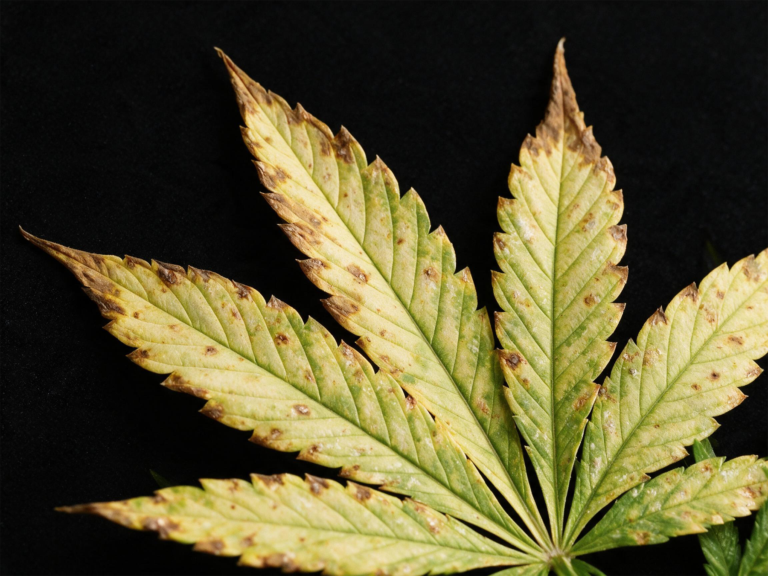
Recognizing Symptoms, Understanding Causes, and Taking the Right Action.
Potassium (K) is one of the three essential macronutrients for cannabis, alongside nitrogen (N) and phosphorus (P).
While nitrogen is primarily responsible for leaf and vegetative growth, and phosphorus supports root development and flower formation, potassium plays a central role in regulating numerous metabolic processes. It controls the plant’s water balance, activates enzymes, strengthens plant tissue, and contributes significantly to flower quality and stress resistance. Both potassium deficiency and potassium excess can severely affect the development of a cannabis plant. Since the symptoms can resemble those of other nutrient disorders, careful diagnosis is especially important.
What Is the Role of Potassium in Cannabis?
Unlike nitrogen or phosphorus, potassium is not incorporated into organic plant structures. Instead, it exists as potassium ions (K⁺) within plant cells, where it performs numerous vital functions.
Its primary roles include:
- Regulating the plant’s water balance
- Controlling stomatal opening and closing
- Activating numerous enzymes
- Transporting sugars and nutrients
- Maintaining cell turgor pressure
- Increasing resistance to heat, drought, and disease
- Supporting vigorous flower development
Potassium demand increases significantly during the flowering stage because the plant transports large amounts of energy and carbohydrates into developing flowers.
Potassium Deficiency in Cannabis
A potassium deficiency occurs when the plant cannot absorb sufficient amounts of potassium (K) to meet its physiological needs. This does not necessarily indicate that the growing medium lacks potassium. In many cases, adequate amounts of the nutrient are present, but environmental or root-zone conditions limit its availability. Common causes include an unsuitable pH, excessive salt accumulation in the root zone, poor root health, or nutrient antagonism.
Because potassium is a mobile macronutrient, the plant can relocate it from older tissues to support actively growing shoots and developing flowers. As a result, deficiency symptoms typically appear first on the older, lower leaves, while new growth initially remains unaffected. Potassium demand increases significantly during the flowering stage, when the plant requires large amounts of this nutrient to regulate water transport, carbohydrate movement, enzyme activity, and flower development. Consequently, potassium deficiencies are most commonly observed during mid to late flowering, when nutrient uptake is at its highest. One of the most frequent causes is nutrient lockout rather than an actual lack of potassium.
If the root-zone pH falls outside the optimal range, potassium remains present in the growing medium but becomes unavailable for uptake. Maintaining the correct pH is therefore essential for efficient potassium absorption.
Recommended pH ranges for optimal potassium availability:
- Soil: pH 6.0–7.0
- Coco coir: pH 5.8–6.3
- Hydroponic systems: pH 5.5–6.2
Common Symptoms of Potassium Deficiency
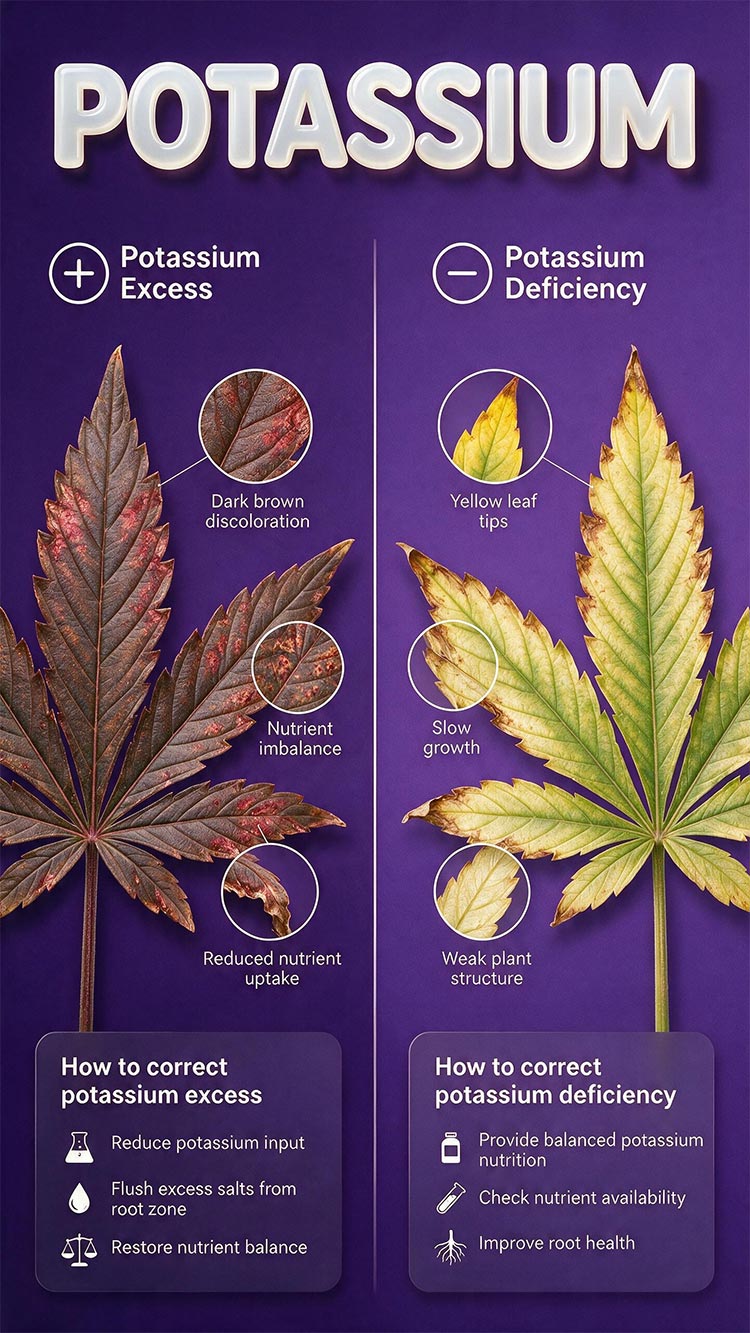
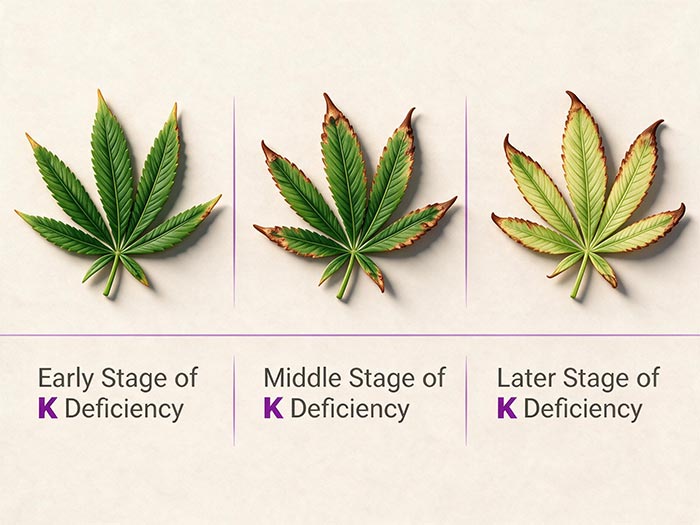
- Yellowing leaf tips is one of the earliest signs: discoloration of leaf tips. They gradually change from healthy green to light green or yellow.
- Yellow and brown leaf margins: as the deficiency progresses, discoloration spreads along the edges of the leaves. The leaf margins begin to dry out and turn brown. This type of damage is commonly referred to as marginal necrosis.
- Burned leaf edges: The edges of affected leaves appear dry and scorched. As the deficiency worsens, dead tissue spreads inward, eventually damaging larger portions of the leaf.
- Slow Growth: Potassium is involved in many metabolic processes. A deficiency often results in noticeably slower growth and weaker lateral branch development.
- Weak Plant Structure Because potassium regulates cell pressure, deficient plants lose structural strength. Stems become thinner and less capable of supporting vigorous growth.
- Reduced Flower Quality: During flowering, potassium deficiency can lead to smaller flowers, reduced resin production, and lower overall crop quality.
Causes of Potassium Deficiency
Potassium deficiency can result from several different factors:
- Insufficient potassium supply
- Depleted growing medium
- Unbalanced fertilization
- Incorrect pH level
- Salt accumulation in the root zone
- Damaged or weakened roots
- Competition with other nutrients such as calcium or magnesium
One of the most common situations is apparent potassium deficiency. In this case, sufficient potassium is present in the growing medium, but unfavorable conditions prevent the plant from absorbing it.
How to Correct Potassium Deficiency
Before adding more fertilizer, the underlying cause should be identified. Recommended steps include:
- Check the pH of the growing medium
- Review the fertilization schedule
- Inspect the roots for waterlogging or damage
- Rule out excessive salt buildup
- Adjust potassium supplementation gradually
Once the problem has been corrected, new growth should develop normally. However, damaged leaves will not regain their healthy green color.
Potassium Excess in Cannabis
Potassium excess usually results from prolonged overfertilization or an imbalanced nutrient program. Interestingly, excess potassium rarely causes direct toxicity symptoms. Instead, the primary problem is that excessive potassium interferes with the uptake of other essential nutrients. The nutrients most commonly affected include: Calcium Magnesium Iron Zinc.
This leads to secondary nutrient deficiencies, even when these nutrients are present in sufficient amounts within the growing medium.
Symptoms of Potassium Excess
- Dark green to bronze-colored leaves
- Leaves may appear unusually dark and develop bronze or brown.
- Discoloration.
- Brown Spots: dry brown necrotic patches may develop on older leaves and gradually spread across the leaf surface.
- Nutrient Lockout: because excessive potassium inhibits the uptake of other nutrients, plants often display symptoms resembling magnesium or calcium deficiency.
- Reduced Growth: although nutrients are abundant, plant development slows because the nutrient balance has been disrupted.
- Reduced Root Activity: high salt concentrations in the root zone stress the roots and reduce their ability to absorb water efficiently.
Causes of Potassium Excess
Common causes include:
- Continuously high fertilizer concentrations
- Excessive or unnecessary feeding
- Bloom fertilizers with excessively high potassium levels
- Poor drainage: salt accumulation in the growing medium
- Excessively high EC levels
How to Correct Potassium Excess
The first step is to adjust the fertilization program.
Recommended measures include:
- Reduce potassium input
- Review fertilizer concentration
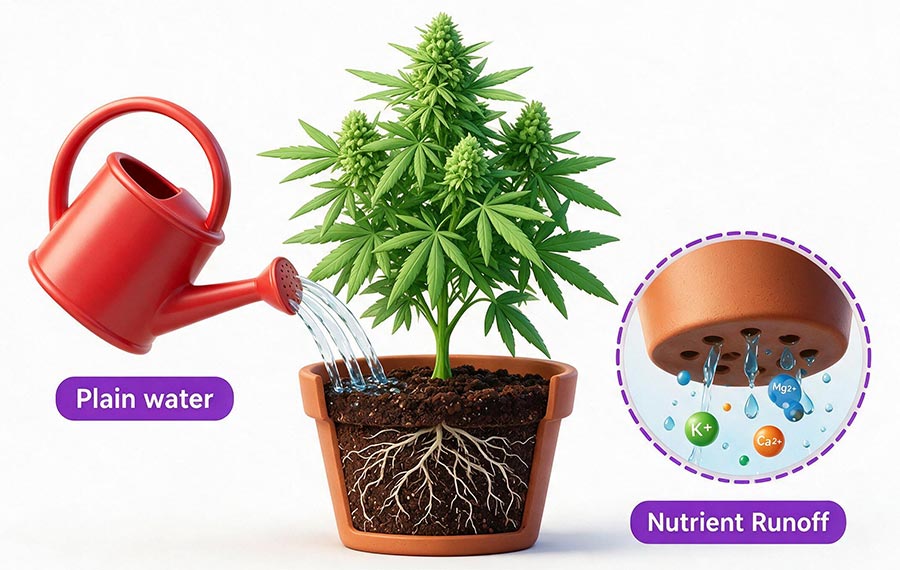
- Carefully flush the growing medium if salt levels are excessive
- Ensure adequate drainage
- Restore a balanced ratio between potassium, calcium, and magnesium
Once the nutrient balance has been restored, healthy growth usually resumes within several days. However, damaged leaf tissue cannot recover.
Old Damage Does Not Disappear Once leaves have been damaged, they will not turn green again after the problem has been corrected. The key indicator of successful treatment is healthy new growth.
Prevention
The best strategy for preventing potassium-related problems is maintaining balanced plant nutrition.
This includes:
- Using high-quality, well-balanced fertilizers
- Regularly monitoring pH
- Avoiding excessive fertilizer applications
- Providing adequate drainage
- Maintaining healthy roots
- Monitoring EC levels regularly when using mineral fertilizers
- A healthy root environment is the most important prerequisite for efficient potassium uptake.
Conclusion
Potassium is one of the most important macronutrients for healthy cannabis development. It influences water regulation, enzyme activity, stress resistance, and flower production.
Deficiency typically causes yellow leaf tips, scorched leaf margins, and weak growth, while excess potassium primarily causes nutrient lockout and secondary nutrient deficiencies.
For an accurate diagnosis, a grower should never rely on a single damaged leaf. Instead, evaluate the entire plant by considering leaf symptoms, growth patterns, root health, pH, and fertilization practices. Professional cultivators always assess the entire growing system before adjusting nutrient levels. This systematic approach helps avoid misdiagnosis and ensures long-term plant health and maximum productivity